|
Back
 x 0 x 0
 x 0 x 0
|
J A P A N
A recession until 2018 is possible
To head it off, governments need to up spending
William Pesek
If Eisuke ‘Mr Yen’ Sakakibara (picture) is right, the global economy is in deep trouble.
He envisions a broad slowdown that might drag on for seven to eight years.
China can live a couple of years without US and European growth, but eight?
 
|
|
Good Post
Bad Post
|
x 0
x 0
|
|
|
Good Post
Bad Post
|
x 0
x 0
|
|
|
Good Post
Bad Post
|
x 0
x 0
|
Tongue
Doctors can tell a lot from your tongue.
A tongue with a warm, pinkish colour is one clue that you are absorbing sufficient iron, folic acid and vitamin B12.
An overly pale and smooth tongue can be a sign of anaemia, while a yellowish tint can suggest fungal infection.
|
|
Good Post
Bad Post
|
x 0
x 0
|
Toilet time
If you're about to have lunch, it might be wise to skip this bit till you've finished. In a word, we're talking stools, because stools can speak volumes about overall health.
It's not so much how often you pass them that's important (unless this suddenly changes) - once a day, three times a day, or even every other day can all be healthy depending on the individual - but consistency and colour.
A good stool is torpedo shaped, soft and easy to pass.
Colour can depend on what you've eaten, but it shouldn't generally be grey, very pale, too dark or bright red. A mid-brown stool, passed easily and regularly without any sudden change in bowel habits is one sign of decent digestive health.
|
|
Good Post
Bad Post
|
x 0
x 0
|
Nails
Men don't pay much attention to their fingernails, but they can give vital clues to general health.
Yellow nails are suggestive of respiratory disease,
spoon-like nails curving outwards can mean iron deficiency anaemia, and
lines going across the nails may be a symptom of diabetes.
Go to the doctor if there's any major change in the look or feel of your fingernails. Firm, pink nails, on the other hand, can be evidence of a decent general level of health.
|
|
Good Post
Bad Post
|
x 0
x 0
|
ABNORMALISATION of Bank Interest Rates
Is
REVERSE PRICE FIXING CARTEL ? ? ? ?
|
|
Good Post
Bad Post
|
x 0
x 0
|
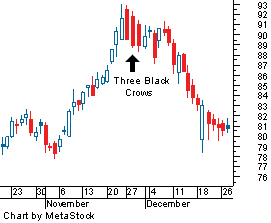
Selling Down Trend towards forming Head and Shoulders Pattern.
epliew ( Date: 13-Dec-2010 14:17) Posted:
What Does Three Black Crows Mean? A bearish candlestick pattern that is used to predict the reversal of the current uptrend. This pattern consists of three consecutive long-bodied candlesticks that have closed lower than the previous day with each session's open occurring within the body of the previous candle.
 |
|
|
|
Good Post
Bad Post
|
x 0
x 0
|
fOr thOse whO get an A Is
educAtion In Class
fOr thOse whO get a D is
Deduction Of cOsts
|
|
Good Post
Bad Post
|
x 0
x 0
|
fOr thOse whO get an A Is
educAtion In Class
fOr thOse whO get a D is
Deduction Of cOsts
|
|
Good Post
Bad Post
|
x 0
x 1
|
fOr thOse whO get an A Is
educAtion
fOr thOse whO get a D is
Deduction Of fees
|
|
Good Post
Bad Post
|
x 0
x 0
|
September 2nd, 2010
Expenses Expenses – Where Does Your Money Go

When life insurance carriers price life insurance policies, there are a number of factors that they need to take into account. The primary issues a life insurance company considers when pricing a policy include the mortality risk of the insured, the amount of insurance being requested and the expenses needed to operate the company.
Expenses are a fact of life for any business. Like most organizations, life insurance companies need to pay salaries,rent, commissions and other operating costs.
Generally you can lump the carriers expenses into two general classes: Ongoing operating expenses and the cost of new business acquisition.
Whole life insurance and Term life insurance policy premiums have their projected costs worked out in the initial pricing of the policy when it is issued, but flexible premium policies like Universal Life Insurance Policies remain sensitive to cost issues for the life of the policy.
The insurer’s ongoing expenses can be dealt with in a number of ways in universal life insurance policies:
Each year, the carrier will apply a percentage of its operating expenses against in force policies. Ongoing expense charges may be deducted from each premium payment when the owner makes her premium payment.
Alternatively , a charge for ongoing expenses may be made monthly from the policy’s cash value, or can be split amongst the existing cash value and the incoming premium.
When ongoing expense charges are deducted from each premium, the policy spec page usually notes the anticipated deduction. Most policies have an expense charge of 4 to 7 percent.
If your carrier is deducting the costs from your cash value instead, then your specifications page will note that the carrier is deducting a percentage of cash value. Generally the costs will be 3-5 cents per $1000 in specified coverage.
The carrier might even specify a fixed monthly policy fee.
The more competitive policy will, of course, tend to have lower expense charges.
Beyond the carriers monthly expense fees, it will also need to recover the costs of finding you as a client and selling you the policy. A typical carrier might spend your first two years in premiums on the costs of getting your policy “on the books.” The agent generally makes 90 to 105 percnet of the first year premium as his commission when he sells the policy. His Broker/General Agency might make another 45% to cover their costs of managing the policy placement process. The carrier also needs to pay for medical records, and underwriters, and analysts, etc.
Excess first-year expenses will be recovered by the carrier over the life of the policy. They may be recovered from each premium received by the company, or will be deducted from the cash value in the form of a surrender charge if the policy is terminated before the costs are fully recovered. A universal life insurance policy’s surrender period may be as short as 10 years or as long as 20 years following the policy issue date.
In general, the carrier is almost always in the red on any policy they sell until the policy has been in force for at least three years, so they structure their charges to discourage consumers from bailing out of a policy until its costs have been recovered and the transaction has been profitable.
|
|
Good Post
Bad Post
|
x 0
x 0
|
IAWIA
Joined: 13 Nov 2010
Posts: 10
|
 Posted: Fri Dec 10, 2010 1:59 pm Post subject: Kudos! Genting Sp Refinance Loan, A Timely & Wise Move! Posted: Fri Dec 10, 2010 1:59 pm Post subject: Kudos! Genting Sp Refinance Loan, A Timely & Wise Move! |
 |
|
It is undeniably that Singapore has made a dramatic entry into the casino-gaming mkt since legalizing it in 2005.
2011 will be the 1st full year of operations for the 2 IRs in the Republic.
Following are some of the interesting estimates made by some of the investment banks/institutions:
PwC : Projected that Singapore's casino revenue to be US$2,8 billion this year and would leapfrog both Australia and S Korea by reaching US$5.5 billion next year(2011)!
CLSA : Projected even more explosive growth for Singapore casino mkt to be worth US$6.5 billion by 2011, matching the Las Vegas Strip and surpassing it in 2012 with a mkt size of US$8.1 billion!
That would easily put Singapore's revenue in the no.2 slot in the Asia-Pacific, behind on Macau
The both timely and wise move by the GSP's management team to take advantage of the positive current development/situation to go into and secure a refinance loan AT THIS JUNCTURE is most commendable!
With such good business sense and skills, the new terms in the new Term Loan could only be, one need not ask, BETTER!
Congrats to all Genting Singapore shareholders! |
|
|
|
Good Post
Bad Post
|
x 0
x 0
|
PRICE FIXING DROVE SUPER PRICES ? ? ? ?
and LED tO EXCESSIVE INFLATION ? ? ? ?
and HIGHLY RISING COST OF LIVING ? ? ? ?
pharoah88 ( Date: 13-Dec-2010 13:03) Posted:
AIRLINES PRICE FIXING CARTEL ? ? ? ?
WHY JUST FINE ? ? ? ?
nO JAIL ? ? ? ?
nO sUspensIOn ? ? ? ?
nO termInatIOn Of CEOs ? ? ? ? |
|
|
|
Good Post
Bad Post
|
x 0
x 0
|
For the sake of the little guy ...
Banking reforms unveiled Down Under to boost bank competition
CANBERRA —
Treasurer Wayne Swan said the reforms aimed to help mutual credit unions and building societies become a fifth pillar of Australia's finance sector, by making it easier for customers to leave the big four banks which currently dominate the home loan market.
The reforms aim to help unlisted credit unions and building societies access funding and customers, but analysts say they are unlikely to seriously hurt the profitability and share values of the major banks.
“Most of what has been announced has been flagged or leaked. I don't think there is anything really new or earthshattering here, so I don't see a huge reaction,” said RBS bank analyst John Buonaccorsi.
“But certainly over time, it will lead to slightly cheaper housing loans, because covered bonds are cheaper funding. But it is not going to cause a dramatic difference.”
Australia's four major banks — the Commonwealth Bank of Australia, National Australia Bank, Australia and New Zealand Banking Group and Westpac — currently control around 87 per cent of Australia's A$1.1-trillion ($1.4 trillion) home loan market.
Shares in the top four banks have slightly underperformed compared to the benchmark index since plans for the bank reforms were mooted last month.
The Australian Bankers Association, which represents the major banks, said some of the reforms would increase competition, but warned some regulatory changes, such as scrapping loan exit fees, could hurt smaller lenders.
“Regulatory interventions may be politically popular but risk being counter-productive. Exit fees reflect legitimate costs of mortgages and banning them will hurt small lenders,” Association chief executive Steven Munchenberg said.
Mr Swan said the government would invest a further A$4 billion in residential backed mortgage securities, a key source of funding to small lenders, would allow more “bullet bonds” for small lenders, and would scrap mortgage exit fees charged by large banks.
He said the government would also increase the powers of the competition regulator to prosecute any collusion among banks through interest-rate price signalling, and will ask former Reserve Bank of Australia governor Bernie Fraser to examine whether it is possible to have portable bank account numbers.
“Vigorous competition is the best way to keep interest rates for borrowers lower over time and create a system that offers real choice,” Mr Swan said.
Mr Swan announced the move to reform the sector early last month in response to growing public anger at rising mortgage rates, with the main banks all lifting rates above official central bank rate hikes and citing the higher cost of funding on international markets.
[SINGAPORE get dIre lOw rates becaUse It Is nOt In the InternatIOnal markets ? ? ? ?]
Australia's top banks rely on offshore debt for a quarter of their annual funding needs and have defended their move to raise rates faster.
They have said the sector has enough competition, though the share of smaller lenders has crumbled.
Mr Swan said yesterday that the government's free guarantee on bank deposits of up to A$1 million would now be made permanent, although regulators may change the A$1 million cap after October next year.
The reform plan is the first of several political attempts to clip the powers of the big banks. The Australian government unveiled reforms to boost bank competition yesterday, allowing lenders to issue covered bonds for the first time and cracking down on interest rate signalling under a package meant to calm voter anger over rising mortgage interest rates.Reuters
|
|
Good Post
Bad Post
|
x 0
x 0
|
Climate talks: Eighteen years, too little action?
Alister Doyle
"I was born in 1992. You have been negotiating all my life. You cannot tell us that you need more time,” Ms Christina Ora of the Solomon Islands complained to delegates at the United Nations talks on fixing global warming.
‘MATTER OF OUR SURVIVAL ’
Surging economic growth in emerging nations led by China and India are helping to ease poverty, but are driving up world emissions even as rich nations’ economies flounder.
Such changes do not sound like much, but the difference between an Ice Age and now is only about 5°C.
A new treaty has eluded the world since a UN Climate Convention was agreed to in Rio de Janeiro in 1992. The convention’s 1997 Kyoto Protocol only binds about 40 rich nations to curb emissions during an initial period ending in 2012.
Outside the conference hall, youth delegates wearing blue T-shirts with Ms Ora’s quote waved banners saying, “1.5 to stay alive”. They say a temperature rise ceiling of 1.5°C is needed to avoid the worst impacts.
Even to some delegates, especially from vulnerable African nations and low-lying islands at risk of sea-level rise, the talks seem like rearranging the deck chairs on the
“This is a matter of our survival,” said Mr Colin Beck, who is also from the Solomon Islands and a vice-chair of the Alliance of Small Island States.
Average world temperatures have already risen about 0.8°C since the Industrial Revolution, and this year is set to be among the top three years on record, vying with 1998 and 2005, since records began in the 19th century. Titanic.
‘THINGS YOU CAN DO NOW’
Despite the gloom, others say a response is happening away from the glacial UN talks, with investment shifts from coal, gas and oil toward renewable energies. China is investing heavily in projects ranging from solar power to high-speed rail links.
“We have been trying to emphasise that the focus should not solely be on the struggles with the treaty negotiations — this word and that word — because there are things you can do now,” World Bank president Robert Zoellick said.
“Business is not sitting back and waiting
for this process to come to a result.
The world is moving ahead anyway,” said Mr Yvo de Boer, climate adviser at audit, tax and advisory group KPMG and a former UN climate chief.
He listed concerns over climate, energy prices, energy security, materials scarcity, consumer preferences and a realisation that things had to change with the world population set to reach 9 billion by 2050 from 6.8 billion now.
The UN panel of climate scientists says it is at least 90-per-cent likely that human activities are the main cause of most of the global warming in the past half-century. Natural causes cannot be completely ruled out.
Mr Rajendra Pachauri, the head of the panel, warned delegates in Cancun that one underestimated effect of climate change was that water expands as it warms, raising the oceans at the same time as more flows in from melting glaciers.
The world is destined to experience a rise in sea levels of 0.4 to 1.4 metres, simply because heat in the atmosphere will gradually reach ever greater ocean depths. Reuters
The writer is Reuters’environment correspondent.
Her line from a brief, riveting speech to a 2009 climate summit in Copenhagen was emblazoned on activists’ T-shirts at the latest United Nations talks in Cancun, Mexico, expressing exasperation at small steps meant to slow floods, droughts, heat waves and rising sea levels.
The two-week, 190-nation conference agreed on Saturday to step up action against climate change, including a goal of US$100 billion ($131 billion) a year to help the poor from 2020 and action to protect carbon-absorbing rain forests.
Almost all admit it fell woefully short of action needed. Cancun underscored that a treaty, as urged by Ms Ora, is out of reach because of disparate economic interests among China, the United States, OPEC oil exporters and Pacific islands.
“Signs that climate change is happening and with catastrophic consequences are there — flooding in Pakistan, heat waves in Russia, China,” Norwegian Environment Minister Erik Solheim said.
“This is a huge step forward, but of course not sufficient based on science,” he said of the Cancun agreements that at least restore some faith in the UN after Copenhagen fell short of the widespread goal of reaching a treaty.
The UN panel of climate scientists in 2007 said greenhouse gas emissions would have to peak by 2015 to give a chance of limiting a rise in average temperatures to 2°C above pre-industrial times — a ceiling agreed to in Cancun.
But, based on current projections, that will not happen.
Existing government policies for combating global warming will lead to a rise in world temperatures of about 3.6°C above pre-industrial times, according to Mr Niklas Hoehne, director of energy and climate policy at consultancy Ecofys.
|
|
Good Post
Bad Post
|
x 0
x 0
|
AIRLINES PRICE FIXING CARTEL ? ? ? ?
WHY JUST FINE ? ? ? ?
nO JAIL ? ? ? ?
nO sUspensIOn ? ? ? ?
nO termInatIOn Of CEOs ? ? ? ?
|
|
Good Post
Bad Post
|
x 0
x 0
|
Hiding does not help
GLP has failed investors in not disclosing non-compete agreement with ProLogis and in saying this is not material information when found out
Global Logistics Properties’ (GLP) response to a recent article in The Business Times article about its failure to disclose a non-compete agreement with United States-based ProLogis in China and Japan appears to be a case of not wanting to admit guilt upon being found out.
Conrad Raj
conrad@mediacorp.com.sg
I am sure investors would have liked to have known about the agreement between the companies, which expires in February.
In just about two months, ProLogis, which sold all its logistics assets in China to GLP in 2008, will be able to compete once again with the Singapore company in China. Many would disagree with GLP and feel that is material information.
GLP says that its prospectus “had not qualified that ProLogis is restricted from competing against the company in China under the non-competition arrangement”.
The GIC subsidiary adds: “In this regard, the company had in its prospectus already treated ProLogis as an existing potential competitor in the same manner as its other potential competitors.”
However, GLP failed to state that despite ProLogis having sold its assets in China to it via GIC Real Estate for US$1.3billion, it could reappear in the market from February next year [2011].
In late 2008, ProLogis exited the China market by selling to GLP 20.7 million sq ft of completed properties and properties under development, as well as about 290 hectares of land. It also sold its interests in five China joint ventures and one property fund, of which the firm’s share amounted to 4.4 million sq ft.
With ProLogis being one of the world’s largest owners, managers and developers of distribution facilities, it could pose as a serious competitor and threat to GLP’s expansion plans in the Middle Kingdom.
GLP now says that it treats ProLogis “in the same manner as any other existing potential competitor that does not currently have a market presence in China”.
It adds that it had declared in its prospectus that it faces increasing competition from a large number of international logistics firms that have expanded or are likely to expand their operations in China.
But this is a general statement that does not disclose the explicit threat from a really solid competitor like ProLogis.
For sure it adds: “We expect many of these providers have sufficient financial, managerial, marketing and other resources to be competitive and may have more experience in logistics facility and land development.”
But why not simply say that one of the major competitors in the very near future could be ProLogis from which it had bought substantial assets?
The man-in-the-street would probably have dismissed ProLogis as a competitor after having only recently sold to GLP its assets in China.
GLP also did not disclose that it was restricted from developing facilities in Japan until February next year. Again it does not think this is material information as it “does not currently have specific plans to develop new facilities or acquire land bank in Japan”. But it did say in the prospectus that if the market conditions are appropriate, it will consider developing new facilities in Japan next year.
The average investor is not interested in the legalese or what the legal interpretation of material or non-material information is.
He or she simply wants to know everything for him or her to make an informed decision.
Hiding does not help, even if it is legal. [hIdIng Is legal ? ? ? ?]
As Mr David Gerald, chief executive and president of the Securities Investors Association Singapore (SIAS), was quoted as saying: “Information that assists with the investment decision or helps an investor in the company make an informed decision ought to be in the prospectus.”
The writer is editor at large at Today.
Developed and managed by GLP China, GLP Park Tongzhou located within the Beijing Tongzhou Logistics Park is one of three logistics bases designated by the Beijing Logistics Development Project and one of Beijing’s major construction projects.
In just about two months, ProLogis, which sold all its logistics assets in China to GLP in 2008, will be able to compete once again with the Singapore company in China.
Many would disagree with GLP and feel that is material information.
The Government of Singapore Investment Corp (GIC)-linked company, which listed on the Singapore Exchange in October, contends that the “existence of the non-competition arrangement between the company and ProLogis is not material, and continues to be nonmaterial to the ongoing business of the company”.
In this era of “caveat emptor” (let the buyer beware), shouldn’t it be left to the buyer to decide what is material and what is not?
Is it not the vendor’s responsibility to disclose information to the fullest, without breaching the Official Secrets Act?
|
|
Good Post
Bad Post
|
x 0
x 0
|
Hiding does not help
GLP has failed investors in not disclosing non-compete agreement with ProLogis and in saying this is not material information when found out
Global Logistics Properties’ (GLP) response to a recent article in The Business Times article about its failure to disclose a non-compete agreement with United States-based ProLogis in China and Japan appears to be a case of not wanting to admit guilt upon being found out.
Conrad Raj
conrad@mediacorp.com.sg
I am sure investors would have liked to have known about the agreement between the companies, which expires in February.
In just about two months, ProLogis, which sold all its logistics assets in China to GLP in 2008, will be able to compete once again with the Singapore company in China. Many would disagree with GLP and feel that is material information.
GLP says that its prospectus “had not qualified that ProLogis is restricted from competing against the company in China under the non-competition arrangement”.
The GIC subsidiary adds: “In this regard, the company had in its prospectus already treated ProLogis as an existing potential competitor in the same manner as its other potential competitors.”
However, GLP failed to state that despite ProLogis having sold its assets in China to it via GIC Real Estate for US$1.3billion, it could reappear in the market from February next year [2011].
In late 2008, ProLogis exited the China market by selling to GLP 20.7 million sq ft of completed properties and properties under development, as well as about 290 hectares of land. It also sold its interests in five China joint ventures and one property fund, of which the firm’s share amounted to 4.4 million sq ft.
With ProLogis being one of the world’s largest owners, managers and developers of distribution facilities, it could pose as a serious competitor and threat to GLP’s expansion plans in the Middle Kingdom.
GLP now says that it treats ProLogis “in the same manner as any other existing potential competitor that does not currently have a market presence in China”.
It adds that it had declared in its prospectus that it faces increasing competition from a large number of international logistics firms that have expanded or are likely to expand their operations in China.
But this is a general statement that does not disclose the explicit threat from a really solid competitor like ProLogis.
For sure it adds: “We expect many of these providers have sufficient financial, managerial, marketing and other resources to be competitive and may have more experience in logistics facility and land development.”
But why not simply say that one of the major competitors in the very near future could be ProLogis from which it had bought substantial assets?
The man-in-the-street would probably have dismissed ProLogis as a competitor after having only recently sold to GLP its assets in China.
GLP also did not disclose that it was restricted from developing facilities in Japan until February next year. Again it does not think this is material information as it “does not currently have specific plans to develop new facilities or acquire land bank in Japan”. But it did say in the prospectus that if the market conditions are appropriate, it will consider developing new facilities in Japan next year.
The average investor is not interested in the legalese or what the legal interpretation of material or non-material information is.
He or she simply wants to know everything for him or her to make an informed decision.
Hiding does not help, even if it is legal. [hIdIng Is legal ? ? ? ?]
As Mr David Gerald, chief executive and president of the Securities Investors Association Singapore (SIAS), was quoted as saying: “Information that assists with the investment decision or helps an investor in the company make an informed decision ought to be in the prospectus.”
The writer is editor at large at Today.
Developed and managed by GLP China, GLP Park Tongzhou located within the Beijing Tongzhou Logistics Park is one of three logistics bases designated by the Beijing Logistics Development Project and one of Beijing’s major construction projects.
In just about two months, ProLogis, which sold all its logistics assets in China to GLP in 2008, will be able to compete once again with the Singapore company in China.
Many would disagree with GLP and feel that is material information.
The Government of Singapore Investment Corp (GIC)-linked company, which listed on the Singapore Exchange in October, contends that the “existence of the non-competition arrangement between the company and ProLogis is not material, and continues to be nonmaterial to the ongoing business of the company”.
In this era of “caveat emptor” (let the buyer beware), shouldn’t it be left to the buyer to decide what is material and what is not?
Is it not the vendor’s responsibility to disclose information to the fullest, without breaching the Official Secrets Act?
|
|
Good Post
Bad Post
|
x 0
x 0
|
|
|
Good Post
Bad Post
|
|
|
|